
The May 2026 Elections: What Every Party is Actually Saying
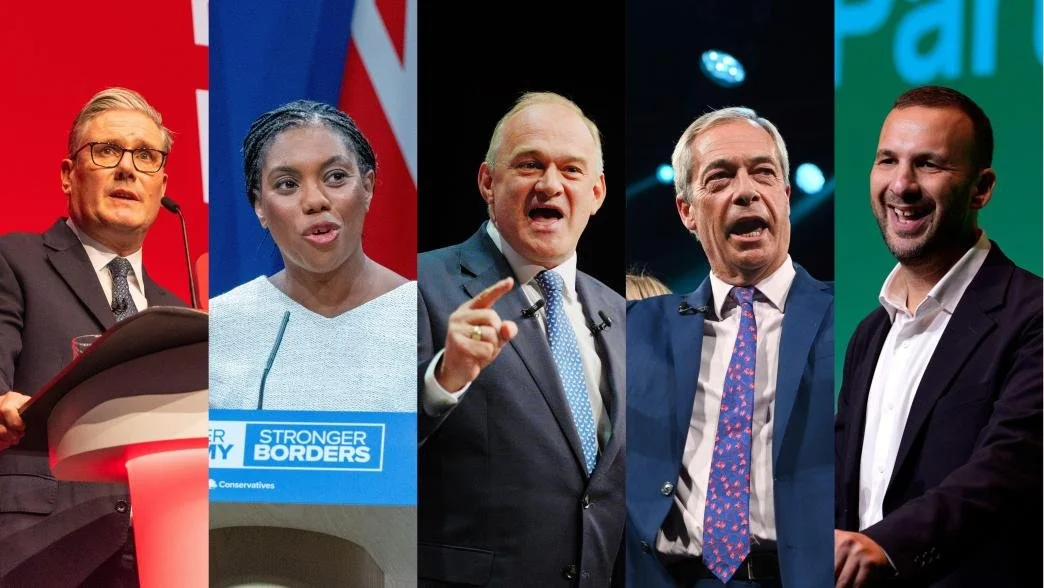
Pictured: UK Party Leaders | Source: Institute for Government
On 7 May 2026, England will hold local elections across 136 councils, over 5,000 seats, while Scotland and Wales held their devolved parliamentary elections on the same day. There are also six mayoral contests and two Welsh council by-elections. With 25,046 candidates nominated across 140 parties, this is one of the most fragmented and politically charged election cycles since the 2024 general election.
The backdrop is unusual: a Middle East war has reshaped energy prices and inflation expectations; the government's first full local election test arrives while its approval ratings have declined; and parties on both the left and right insurgent flanks are hoping to consolidate gains. Here is where each of the major parties stands.
Labour
The governing party is fighting to hold its council base against a squeeze from both sides. Its core message remains economic stability: clean energy investment, NHS reform, and planning reform to build more homes. The energy security debate has created internal tension: some Labour figures want North Sea drilling approved; others, including Energy Secretary Ed Miliband, remain committed to the net-zero path. On financial regulation, Labour has broadly supported the FCA's growth agenda while maintaining the Consumer Duty. Labour's challenge is that many of its 2024 majority came from voters who are now frustrated by slow delivery and rising energy bills.
Conservatives
Under Kemi Badenoch, the Conservatives are making the case for economic deregulation, tax cuts, more domestic energy production (including North Sea), and tighter immigration controls. On financial regulation, Badenoch's Conservatives have been critical of what they call regulatory burden and are broadly supportive of accelerating the 'smarter regulator' agenda. Their local election pitch centres on economic competence and opposing welfare cuts. The party hopes to win back councils lost in 2022 and stabilise after a turbulent period of leadership changes.
Reform UK
Nigel Farage's Reform UK, polling in the 20%+ range nationally, is targeting coastal and post-industrial councils where its anti-immigration, anti-net-zero, and anti-establishment message has strong resonance. On financial regulation, Reform is broadly deregulatory and explicitly hostile to ESG obligations on business. Its climate position is that the UK's net-zero commitments damage economic competitiveness and should be revisited. A strong Reform showing, particularly in Scotland and England's North and Midlands would signal sustained pressure on both major parties.
Liberal Democrats
The Lib Dems are fighting to maintain strength in their traditional heartlands — affluent suburban England, university towns, and Scotland. Their message is centrist: fiscal responsibility, investment in public services, stronger environmental regulation, and a pro-European economic posture. On financial matters, they are supportive of proportional representation in voting and stronger investment in green infrastructure. They are unlikely to make large-scale gains but should hold most of their 2022 and 2024 gains.
Green Party
The Greens are polling strongly and are hoping to convert national momentum into council seats, particularly in urban areas. Their platform centres on a rapid green transition, a wealth tax, rent controls, and strengthening environmental regulation. They are likely to take seats from Labour in progressive urban wards where the government's energy policy is seen as insufficiently ambitious.
SNP and Plaid Cymru
In Scotland, the SNP is defending a majority at Holyrood after a turbulent period including the Humza Yousaf leadership crisis and the recent transition to John Swinney. Scottish independence remains a defining issue, but the party is also campaigning on NHS reform and net-zero. In Wales, Plaid Cymru is hoping to end Labour's dominance at the Senedd, potentially forcing a coalition. Both parties support proportional representation and ambitious climate policy.
For regulated businesses, the key question from these elections is less about who wins councils and more about the political signal they send. A strong Reform UK showing would accelerate pressure on regulators to demonstrate growth-friendliness. A strong Green showing puts pressure in the other direction.
The Legal Angle: What Election Outcomes Mean for the Statute Book
Elections have direct consequences for lawyers and legal teams because they drive the legislative pipeline. A Labour government that loses significant ground in May faces mounting pressure to dilute its Employment Rights Act 2025 provisions particularly around trade union rights and zero-hours contracts. Any firm currently conducting workforce restructuring will want to know whether employment law as written in October 2025 is the law that will be in force in October 2026.
On the regulatory front, a strong Reform UK showing would add political momentum to arguments for judicial review of FCA and PRA rulemaking, particularly in ESG, Consumer Duty, and climate-related disclosure areas. The courts have been an increasingly active space for challenging delegated legislation and regulator-made rules, the Rosebank offshore drilling judicial review (which held that the government had failed to adequately assess downstream emissions) is a recent example of how litigation can reshape policy. Companies considering major capital decisions in regulated sectors should model the legal risk of a policy environment that is more volatile than it was 18 months ago.
In Scotland and Wales, devolved election outcomes create genuine legal complexity for cross-border businesses. Scottish contract law already diverges materially from English law in commercial property, insolvency, and certain employment matters. A change of government at Holyrood or a Plaid-Labour coalition at the Senedd could accelerate divergence in consumer protection obligations, planning consent for energy infrastructure, and environmental liability, all areas with direct relevance to financial services firms operating across the UK.